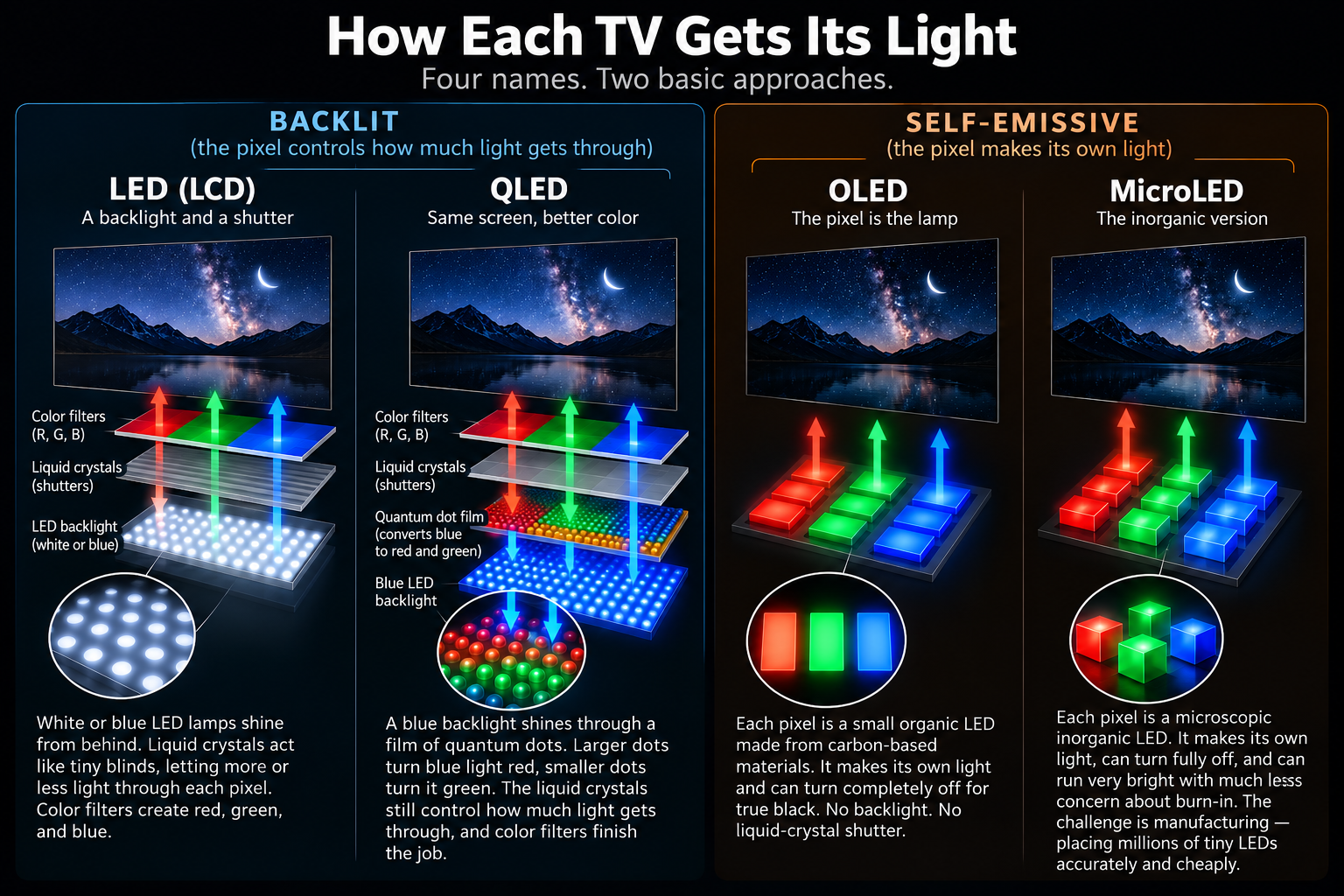
Two basic approaches, four brand names. Backlit displays (LED, QLED) shine a lamp through a liquid-crystal shutter. Self-emissive displays (OLED, MicroLED) skip the backlight — each pixel makes its own light and can switch off completely.
Buying a TV used to be a size and a price. Now the box says LED, QLED, Mini-LED, Micro RGB, OLED, or MicroLED, and none of those words mean quite what they sound like.
They are all answers to the same problem. You need millions of pixels to show the right color, fast enough that a movie looks like motion.
The split that matters is simple. Either a lamp sits behind the screen and the pixel only decides how much light to let through, or the pixel is the lamp.
📺 LED: A Backlight and a Shutter
An LED TV is an LCD. Liquid crystals do not glow. Their orientation changes when a voltage is applied, a little like a tiny venetian blind, and that controls how much backlight gets through. Red, green, and blue filters in front of the blinds make the color.
That is why these sets are bright, cheap, and common, and why a night scene often looks dark gray instead of black. The lamps are still on. The blinds cannot close perfectly, so a little light leaks through.
Better sets fight that with local dimming. The backlight is split into zones, and zones behind a dark part of the picture get turned down. Mini-LED is the same idea with much smaller lamps, so the zones can be smaller.
It helps. It does not make each pixel its own light. A streetlamp in a night shot can still throw a faint halo.
The panels last a long time. They do not last forever. The backlight slowly dims with use, like any lamp.
🌈 QLED: Same Screen, Better Color
QLED starts with that same LCD and adds a film of quantum dots between the backlight and the crystals.
A quantum dot is a semiconductor crystal a few nanometers across. Size is the color. Squeeze the crystal smaller and the light it gives off shifts toward blue. That is quantum confinement: the smaller the box, the bigger the energy gap, the shorter the wavelength.
In a typical QLED TV the backlight is blue, not white. Bigger dots turn some of that blue into red. Smaller dots turn some into green. The blue that is not absorbed goes through.
A color filter still sits in front, and the liquid crystals still have to control the light. The dots make the colors purer while allowing a bright display, which is why these sets hold up well in a sunny room.
They do not fix the black-level problem.
Under the film, it is still a backlight.
⚫ OLED: The Pixel Is the Lamp
OLED drops the backlight. Each pixel produces its own light using organic, carbon-based compounds that glow when electrically excited.
If the scene wants black, that pixel turns off. Nothing is shining behind it, so nothing has to be blocked.
That is the contrast people notice. It also holds up well if you are sitting off to the side because OLED does not rely on an LCD backlight passing through the same stack of layers.
Organic materials do wear with use. A static logo shown repeatedly for thousands of hours can eventually leave a ghost. Pixel-shifting, panel-refresh routines, and other techniques help reduce that risk.
For ordinary mixed viewing, burn-in is usually not a major concern. It is not gone, though, especially if the same bright graphics stay on the screen day after day.
🔬 MicroLED: The Inorganic Version
Real MicroLED takes the self-emitting idea and builds it from inorganic LED material. Each pixel is its own microscopic lamp. It can go fully off, and it can run extremely bright with much less concern about burn-in than OLED.
Stadium screens use the same basic family of light-emitting technology, just at a much larger scale.
The hard part is building the thing.
Millions of microscopic LEDs have to be placed onto a backplane accurately, quickly, and with very few defects. One way of doing that is called mass transfer, and it remains one of the big manufacturing challenges behind MicroLED.
That is why true MicroLED displays are still extremely expensive and uncommon in ordinary living rooms.
But there is a new wrinkle.
Read the box carefully this year.
Samsung's 2026 Micro RGB sets, along with similar RGB-backlight sets from other manufacturers, can sound a lot like MicroLED. They are not the same thing.
Micro RGB uses tiny red, green, and blue LEDs as the backlight behind an LCD panel. The pixels themselves are still controlling light coming from behind them. Samsung's 2026 lineup started at about $1,600 at launch for a 55-inch model.
So the "micro" part does not automatically mean the pixel makes its own light.
Better color. Very sophisticated backlighting. Still a shutter.
🛒 Which One to Buy
- Bright room, ordinary budget: LED or QLED. If you can pay a bit more, look for local dimming or Mini-LED so the blacks are darker without giving up brightness. And if the box says Micro RGB, do not confuse it with MicroLED.
- Dark room, movies, games: OLED. The blacks, contrast, and fast response are differences you can actually see.
- Money is not the limit, and the set is practically a wall: true MicroLED. Early, expensive, and definitely not the same thing as this year's Micro RGB TVs.
The split is still the simplest way to remember all of this: