

Fusion Isn't Waiting for New Physics
It's waiting for better engineering.
For seven decades, nuclear fusion carried the exact same tired reputation: it was always "30 years away." If you've followed science or tech news for any length of time, you've probably heard that running joke more times than you can count.
For the first time in history, that joke is finally getting old!
What changed recently wasn't a brand-new, undiscovered law of physics. The real breakthrough happened in engineering and materials science. A new generation of super-powerful magnets — made from high-temperature superconducting (HTS) materials — can generate magnetic fields strong enough to trap superhot plasma in reactors much smaller than anyone previously thought possible.
Why does reactor size matter so much? Because size drives almost everything:
- How much the reactor costs to build
- How quickly it can be constructed
- How fast engineers can test and tweak designs
- Whether private companies can afford to build these machines without waiting decades for government grants
Right now, Commonwealth Fusion Systems (CFS) is constructing its SPARC reactor in Devens, Massachusetts, aiming to demonstrate net fusion energy by 2027. Meanwhile, ITER — the massive 35-nation international effort in France — is continuing assembly, with scientific operations scheduled for 2034.
Since 2021, private fusion companies have pulled in over $13 billion in private investment.
For the first time ever, fusion isn't just relying on physics promises — it's running on real engineering deadlines.
I've been following fusion research for 35 years, and here is what most news coverage gets wrong: the physics was never really the problem.
The electromagnetics are well understood. Maxwell's equations don't need a patch update. Nuclear physics didn't suddenly rewrite itself overnight.
What has always stood between us and practical, plug-into-the-grid fusion power comes down to pure engineering:
- Can we build magnets strong enough?
- Can we develop materials tough enough to survive inside the reactor environment?
- Can we manufacture our own tritium fuel right inside the machine while it runs?
- Can we keep the reactor running continuously, rather than just in short experimental bursts?
Those aren't small questions by any means! But they are engineering questions.
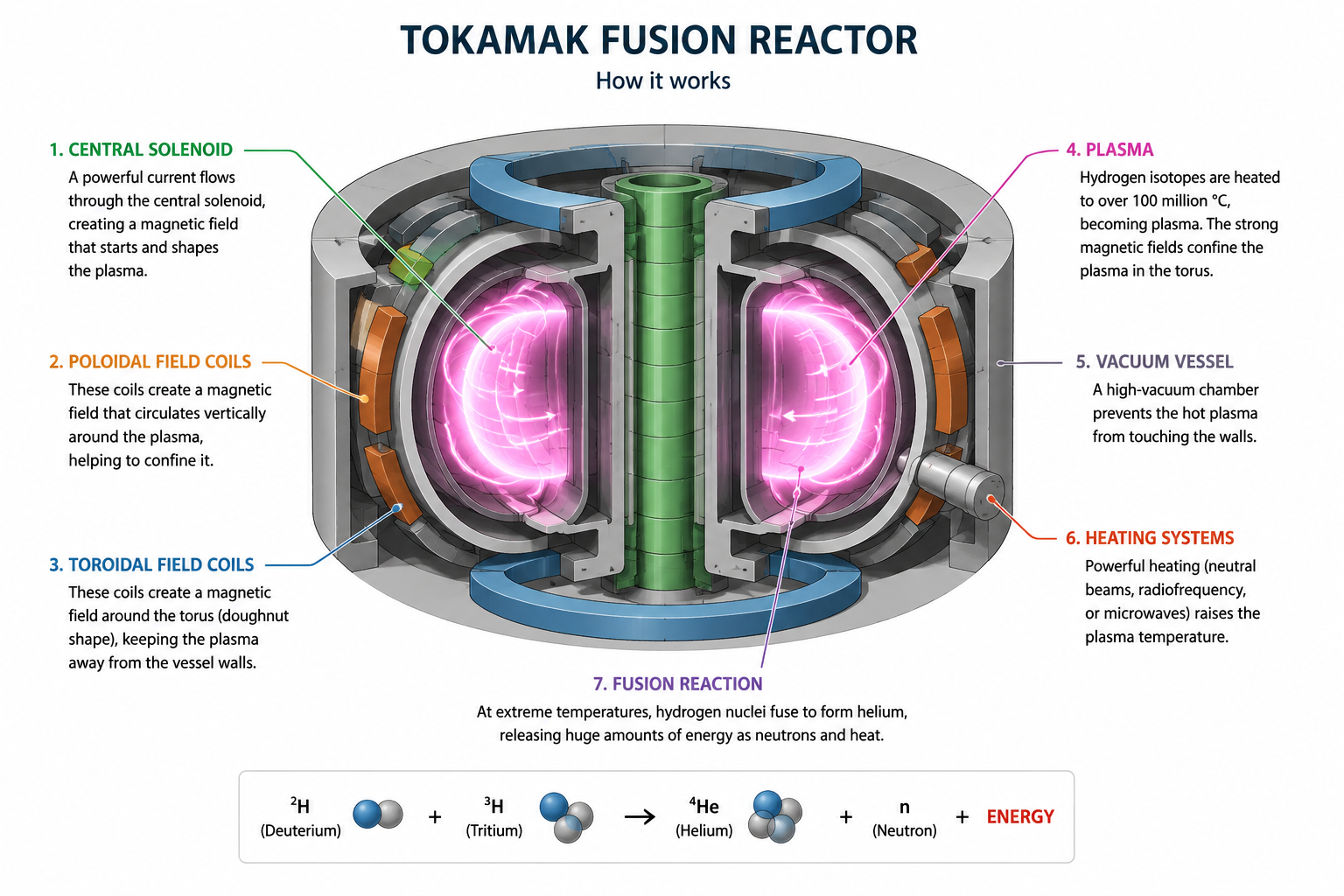
High-temperature superconducting magnets answer that first question in a massive way. By giving us much stronger magnetic fields, they completely rewrite the size and cost equation for tokamaks.
The physics gave us the blueprint 70 years ago.
Engineering is finally catching up.
How Does Nuclear Fusion Actually Work?
The Basic Idea
Fusion happens when two light atomic nuclei — typically two heavy forms of hydrogen called deuterium and tritium — are squeezed together so hard that the strong nuclear force takes over. They fuse together into a single helium nucleus, spitting out a high-energy neutron and releasing a massive amount of energy.
This is the exact same process that powers the Sun. The big difference? The Sun has massive gravity helping it crush atoms together. On Earth, we don't have that kind of gravity, so we have to replace the Sun's weight with clever engineering.
Getting It Started
Fusion isn't something you can light with a match. To get the atomic nuclei moving fast enough to overcome their natural resistance to each other, the fuel has to be heated to extreme temperatures. In a donut-shaped reactor called a tokamak, engineers heat the plasma using three main methods at the same time:
- Ohmic Heating — A powerful electric current runs directly through the plasma, heating it up just like electricity heats up the wire in a toaster.
- Neutral Beam Injection — High-energy neutral atoms are shot right into the plasma like tiny billiard balls, transferring their energy through collisions.
- Radio-Frequency Heating — High-power electromagnetic waves — tuned much like high-tech microwaves — beam energy directly into the charged particles.
In contrast, facilities like the National Ignition Facility (NIF) use a completely different technique called inertial confinement: they zap a tiny fuel pellet from all sides using 192 synchronized laser beams, briefly recreating conditions similar to the core of a star.
Regardless of the approach, the goal is to satisfy the Lawson Criterion: finding the perfect balance of temperature, plasma density, and confinement time. You need all three! High temperature alone won't cut it.
The Main Problem
Atomic nuclei are positively charged, so they naturally push away from each other. To force them together, deuterium-tritium fuel has to reach temperatures over 100 million °C — several times hotter than the center of the Sun!
At those extreme temperatures, gas turns into plasma: a superheated soup of free electrons and positive nuclei. Since no solid material on Earth can survive direct contact with something that hot, engineers use powerful magnetic fields to suspend the plasma in mid-air inside the tokamak's donut chamber. You are essentially trying to hold a star inside an invisible magnetic bottle without letting it touch the metal walls.
The Big Milestone (Q > 1)
For fusion to be useful for clean energy, it must produce more energy than it takes to keep the reaction going — a milestone known as net energy breakeven (Q > 1).
In December 2022, scientists at the National Ignition Facility crossed this line for the first time in history: they fired 2.05 Megajoules (MJ) of laser energy at the fuel pellet and got 3.15 MJ of fusion energy back. While this was a monumental physics accomplishment, it wasn't a commercial power plant design. Projects like SPARC are using high-field HTS magnets because that magnetic approach points much more directly toward a practical, commercial grid design.
💡 Quick Unit Check: What Is a Megajoule?
We measure energy in fusion experiments using megajoules (MJ).
- 1 Joule — A tiny unit of energy — roughly what it takes to lift a small apple one meter off the ground.
- 1 Megajoule (MJ) — One million joules!
To give you a real-world feel for what a megajoule looks like:
- A 500-Calorie hamburger contains about 2.1 MJ of chemical energy (enough to power a 100-watt light bulb for almost six hours).
- A gallon of gasoline contains about 132 MJ.
- An average U.S. household uses about 30 kilowatt-hours per day (roughly 108 MJ).
- A bolt of lightning releases about 1 to 5 MJ in a fraction of a second.
Why the NIF result mattered: the NIF experiment produced 3.15 MJ — about the chemical energy in a hamburger and a half — from 2.05 MJ of laser energy. The big deal wasn't the total amount of energy generated; it was the ratio. For the first time ever, a controlled fusion experiment produced more energy than the energy delivered to the fuel. The physics works! Now engineering has to scale up that output by orders of magnitude.
The Fuel Situation
Deuterium — the easy half of the equation! It can be extracted directly from seawater, and the Earth's supply is practically endless.
Tritium — the tricky half. Tritium is radioactive, extremely rare, and very expensive. A commercial power plant can't just buy tritium off the shelf. Instead, it has to breed its own tritium while it operates! The reactor walls will be lined with "breeding blankets" containing lithium. When escaping high-energy neutrons hit the lithium, they produce fresh tritium fuel. That means a future fusion plant is both a power generator and its own fuel factory!
📊 How Does Fusion Compare to Other Energy Sources?
| Feature | Fossil Fuels* | Fission (Nuclear) | Renewables | Fusion |
|---|---|---|---|---|
| Emissions | Pollution | None | None | None |
| Reliability | Dispatchable | Constant baseload | Variable (weather dependent) | Constant baseload potential |
| Fuel Supply | Limited but large | Limited, but large | Renewable | Unlimited deuterium; tritium bred in-house |
| Waste | Ash | Long-lived radioactive waste | Minimal | Short-lived activation waste (decades, not millennia) |
| Main Risk | Pollution | Meltdown risk & long-term waste | Intermittency / grid storage | Plasma shutdown (reaction simply stops) |
Note on safety: fusion is not a chain reaction. If magnetic confinement slips or fails, the plasma instantly cools down and the reaction stops. It can't melt down!
*A future Signal issue will dig deeper into the fossil fuel controversial picture.
🏫 Where the Research Happens
If a student asked where the big academic action is taking place today, these universities and labs would top the list:
- MIT (Plasma Science and Fusion Center) — Commonwealth Fusion Systems spun directly out of MIT. Their pioneering work on HTS magnets proved that smaller, high-field tokamaks were realistic.
- Princeton (Plasma Physics Laboratory — PPPL) — Deep roots in magnetic fusion, plasma theory, spherical tokamaks, and exciting concepts for fusion space propulsion.
- University of Rochester (Laboratory for Laser Energetics) — One of the premier academic centers for laser-driven fusion, closely tied to the physics behind NIF's ignition milestone.
- UC San Diego (Center for Energy Research) — Closely linked with General Atomics and DIII-D, the largest operating tokamak research facility in the U.S.
- University of Wisconsin–Madison — Home to the HSX stellarator experiment, exploring an alternative "twisted-donut" reactor design.
Other notable research hubs include UT Austin, Oxford University, Eindhoven University of Technology, and the Max Planck Institute in Germany.
🛠️ What It Takes to Work in This Field
The path into fusion starts with electromagnetism. Keeping 100-million-degree plasma trapped inside a magnetic box is essentially Maxwell's equations pushed to the absolute extreme.
While a Ph.D. is usually expected for high-level research at national labs, private fusion companies like CFS, TAE Technologies, and Helion are hiring heavily across many engineering fields:
- Nuclear Engineering — Direct undergraduate path into reactor design.
- Electrical Engineering — Superconducting magnets, high-voltage power systems, and RF heating.
- Mechanical & Materials Engineering — Vacuum vessels, cryogenic cooling systems, and heat-resistant materials.
- Computer Science & Computational Physics — Real-time plasma control algorithms and supercomputer simulations.
Fusion isn't just an academic physics career anymore — it's turning into a full-fledged engineering industry!
🚀 Could Fusion Leave Earth?
The most thrilling application of fusion might not be powering cities — it might be exploring deep space.
- Chemical Rockets — Max out at around 450 seconds of specific impulse (fuel efficiency).
- Ion Electric Drives — Super efficient (3,000 to 10,000 seconds), but produce very little thrust — like the push of a piece of paper.
- Fusion Propulsion — Offers high efficiency and powerful thrust at the same time!
The Direct Fusion Drive (DFD) concept being researched at Princeton uses an elongated magnetic container (a field-reversed configuration). Hot plasma is directed out the back through a magnetic nozzle to push the spacecraft forward, while also tapping off electricity to power onboard computers and scientific instruments.
U.S. Department of Energy, DOE National Laboratory Makes History by Achieving Fusion Ignition (December 13, 2022) — energy.gov
Lawrence Livermore National Laboratory / National Ignition Facility, Achieving Fusion Ignition — lasers.llnl.gov (2.05 MJ laser in → 3.15 MJ fusion out, December 5, 2022)
Commonwealth Fusion Systems, SPARC project overview — cfs.energy (Devens, MA; net energy Q>1 goal 2027)
ITER Organization, New Baseline to Prioritize Robust Start to Exploitation — iter.org (research operations start 2034)
Fusion Industry Association, Global Fusion Industry Report 2025 — fusionindustryassociation.org (cumulative investment >$13B as of mid-2026)
MIT News / MIT Plasma Science and Fusion Center, MIT-Designed Project Achieves Major Advance Toward Fusion Energy (September 8, 2021) — news.mit.edu (20 tesla HTS magnet record)
Chinese Academy of Sciences, Chinese "Artificial Sun" Sets New Record (January 21, 2025) — english.cas.cn (EAST: 1,066-second plasma confinement record)
NASA Innovative Advanced Concepts (NIAC), Fusion-Enabled Pluto Orbiter and Lander — nasa.gov (Princeton Direct Fusion Drive)
UK Atomic Energy Authority, STEP programme — ukaea.org (West Burton, Nottinghamshire)
TAE Technologies, First Measurements of Hydrogen-Boron Fusion in a Magnetically Confined Fusion Plasma — tae.com
Princeton Plasma Physics Laboratory / Princeton Satellite Systems, Direct Fusion Drive publications — pppl.gov
The Lens That Fits on a Fingertip
A Harvard spinoff is shipping optical sensors thinner than a strand of hair that bend light with precision — no glass, no curves, no centuries-old engineering required.
For four centuries, the only way to bend light was to curve glass. Every telescope, microscope, camera, and pair of eyeglasses in human history depended on that same principle: shape the glass, shape the light. In 2023, a company called Metalenz started shipping sensors that break that rule entirely.
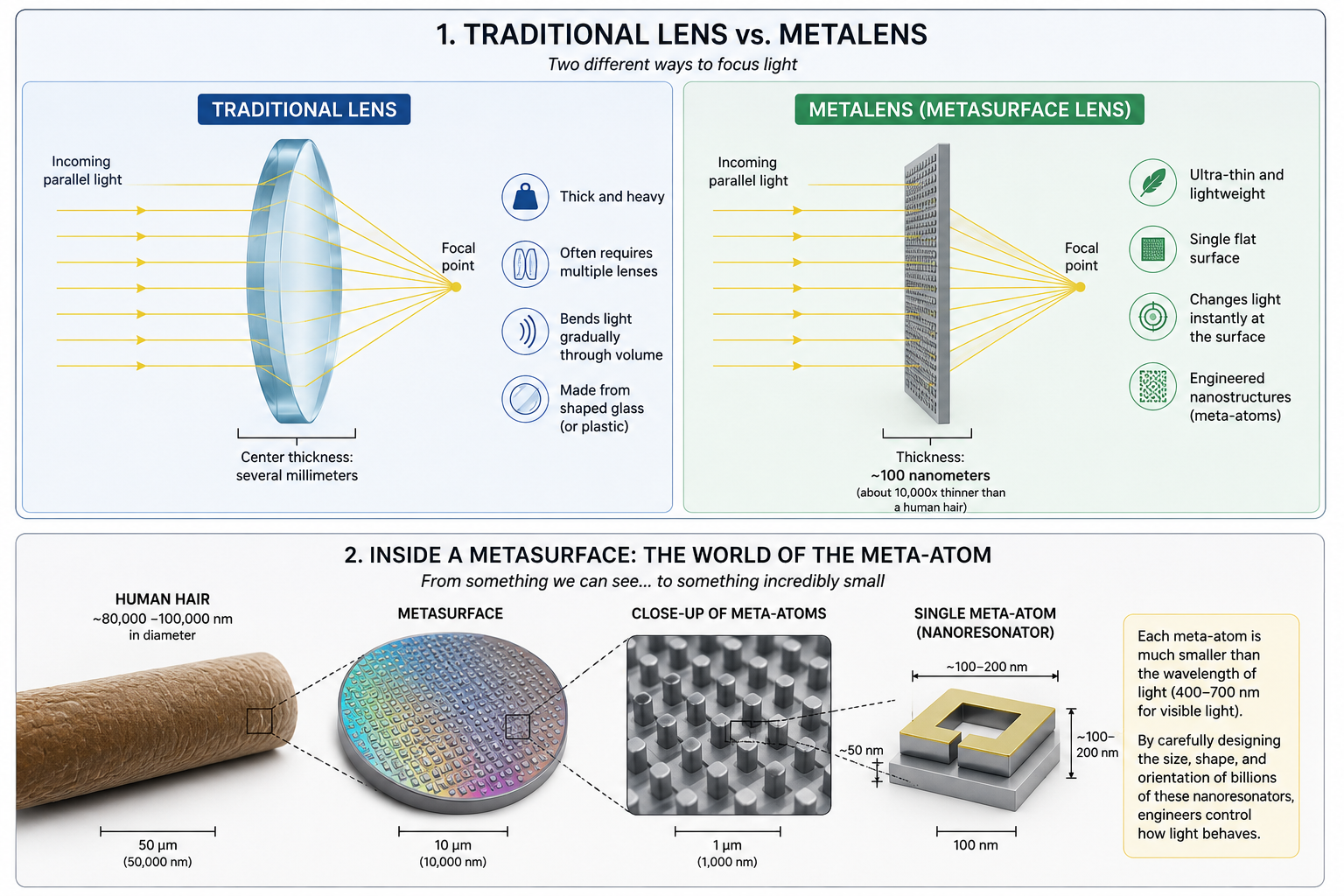
Metalenz was founded by Federico Capasso, a physicist at Harvard who spent years studying how light interacts with surfaces at the nanoscale. The product is a metalens — a flat disc of silicon, thinner than a human hair, covered with millions of precisely engineered pillars roughly 200 nanometers wide. Each pillar is designed to delay the phase of passing light by a specific amount. Together, they add up to a lens that focuses with the same optical precision as ground glass, at a fraction of the size, weight, and manufacturing complexity.
The sensors initially targeted 3D sensing and LiDAR applications — the kind of depth detection used in face unlock and autonomous vehicles. But the implications go well beyond that. A metalens can be designed to serve multiple optical functions simultaneously. A single flat surface can focus, filter, and polarize light at the same time. In conventional optics, those functions require separate elements stacked in sequence. The entire optical train can now be collapsed onto one patterned surface.
This is not a laboratory curiosity. It is the first wave of a technology that has been building in physics journals since 2011, when Capasso's group demonstrated that nanoscale antennas on a surface — arranged in the right pattern — could redirect light in programmable directions. That paper in Science became one of the most cited in optics over the following decade. What changed between then and 2023 is manufacturing: the same semiconductor fabrication tools used to make computer chips can now pattern silicon at the length scales required for optical metasurfaces. The production line was already there. Metamaterials just had to meet it.
Sources: Metalenz Inc. (2023–2024); Yu, N. et al., Science (2011); Khorasaninejad, M. & Capasso, F., Science (2017)
When the Structure Is the Material
The Basic Idea
A metamaterial is not a new chemical compound. It is not discovered in a mine or synthesized in a reaction vessel. A metamaterial is an engineered structure — an arrangement of shapes, gaps, and periodic patterns at a scale smaller than the wavelength of whatever wave you are trying to control. The structure itself becomes the material's identity.
Nature builds materials from atoms. Metamaterials build from engineered "meta-atoms" — small resonant structures, often made of copper, silicon, or gold — arranged so that their collective response to electromagnetic radiation, sound, or mechanical stress is something no natural substance produces. The physics does not change. Maxwell's equations are not being violated. What changes is that engineers are exploring a region of material-property space that nature, in four billion years of chemistry, never happened to fill.
Refractive Index: A Quick Primer
When light travels from one medium into another — from air into glass, for example — it bends. That bending is described by Snell's Law: the angle of bending depends on the ratio of the two media's refractive indices. The refractive index n tells you how much slower light travels in that medium compared to a vacuum. Air has n ≈ 1.0. Glass has n ≈ 1.5. Diamond has n ≈ 2.4.
Crucially, the refractive index is not the same for every color of light — it varies with wavelength. Shorter wavelengths (violet, blue) bend more than longer wavelengths (red). This is called dispersion, and it is the entire reason a glass prism splits white light into a rainbow of colors, and why rainbows appear in the sky: water droplets act as tiny prisms, bending each wavelength at a slightly different angle. This wavelength-dependence of n turns out to be a critical limitation for metalenses, as we'll see shortly.
In every natural transparent material, the refractive index is a positive number. Light bends toward the normal when it enters a denser medium. This is so universal that for most of physics history, it was simply assumed to be the only possibility.
The Negative Index Discovery
In 1967, Victor Veselago, a physicist at the Moscow Institute of Physics and Technology, published a theoretical paper asking a simple but radical question: what would happen if a material had both a negative electric permittivity (ε < 0) and a negative magnetic permeability (μ < 0) simultaneously? He showed, using Maxwell's equations alone, that such a material would have a negative refractive index — light entering it would bend the wrong way, on the same side of the normal rather than the opposite side. It would also support a Doppler effect running in reverse and radiation pressure that pulls rather than pushes. Veselago called it a "left-handed medium."
The paper was largely ignored for three decades. The reason was simple: no one could make such a material. Natural substances never have both ε and μ negative at the same frequency. Metals have negative permittivity (which is why they reflect light) but positive permeability. Magnetic materials can have negative permeability but only at very low frequencies. Getting both simultaneously in the same frequency band seemed physically impossible.
In 2000, David Smith at the University of California San Diego built it. His team constructed a composite structure — alternating sheets of thin copper split-ring resonators and straight copper wires embedded in circuit board material. The rings created a magnetic resonance that drove μ negative. The wires drove ε negative. At microwave frequencies, the combination produced n = −1. Veselago's 1967 prediction was confirmed by an experiment that looked, at close range, like circuit board scraps arranged in a periodic lattice. Shelby, Smith, and Schultz published the experimental verification in Science in 2001, and the field exploded.
What Negative Refraction Enables
A negative refractive index is not just a curiosity. It unlocks optical capabilities that are physically impossible with conventional materials.
The most famous is the perfect lens. In normal optics, there is a hard limit on how finely you can focus light: the diffraction limit, roughly half a wavelength. Microscopes, lithography machines, and optical data storage all run up against it. In 2000, John Pendry at Imperial College London showed theoretically that a flat slab of negative-index material could act as a perfect lens — one that focuses not just the propagating waves (which carry the image you can normally see) but also the evanescent waves (which decay away from the surface and carry the subwavelength detail you normally lose). A perfect lens has no diffraction limit. It could, in principle, image details far smaller than the wavelength of the light used to form the image.
The second famous application is electromagnetic cloaking. In 2006, David Schurig, David Smith, and John Pendry published a paper in Science demonstrating the first working electromagnetic cloak. It worked at microwave frequencies. A ring-shaped metamaterial guided microwave radiation around an object in its center. To a microwave detector on the other side, the object was not there. The cloak was imperfect and narrow-band, but the physics was real.
Types of Metamaterials
Electromagnetic metamaterials get most of the press, but the structural approach extends across every wave phenomenon in physics.
- Electromagnetic / optical metamaterials — Designed to control radio waves, microwaves, infrared, or visible light. Applications include radar absorbers, flat lenses, cloaks, and antenna miniaturization.
- Acoustic metamaterials — Periodic arrangements of cavities and channels that control sound waves. Applications include perfect sound absorbers, noise barriers, and vibration isolation in automotive and aerospace structures.
- Mechanical / elastic metamaterials — Engineered lattice geometries that produce extreme mechanical properties, including negative Poisson's ratio. Useful for protective equipment, aerospace panels, and soft robotics.
- Seismic metamaterials — Large-scale periodic structures designed to scatter or redirect seismic waves, potentially protecting buildings from earthquake ground motion.
- Thermal metamaterials — Engineered composites that steer heat flow around an object. Useful for thermal management in electronics and spacecraft.
Metasurfaces: The Practical Version
Volumetric metamaterials are difficult to fabricate at optical frequencies. The engineering community converged on a more practical approach: the metasurface — a single, ultrathin layer patterned on a flat substrate. Rather than accumulating a phase shift as light propagates through a thick medium, a metasurface imposes an abrupt phase shift right at the surface. By engineering the size, shape, and orientation of each antenna element at each point, designers can specify exactly how much the phase changes at every location. The result is a flat optical element that can focus, deflect, split, collimate, or reshape a beam — all in a layer thinner than a wavelength.
The manufacturing key is that metasurfaces are patterned using standard semiconductor lithography. The same equipment that makes computer chips. Silicon wafers, deep-UV exposure, reactive ion etching. The feature sizes required are already within the reach of commercial foundries. That is why Metalenz can ship product: the optics problem was solved in the physics lab; the manufacturing problem was already solved by the semiconductor industry.
How Does This Compare to Conventional Optics?
| Property | Conventional Glass Lens | Diffractive Optical Element | Metasurface / Metalens |
|---|---|---|---|
| Thickness | Millimeters to centimeters | Sub-millimeter | Sub-wavelength (<1 µm) |
| Weight | Significant | Low | Near-zero |
| Fabrication | Precision grinding / molding | Lithography | CMOS-compatible lithography |
| Broadband performance | Excellent (with corrections) | Strong chromatic aberration | Improving; achromatic designs demonstrated |
| Multi-function | One function per element | One function per element | Focus + filter + polarize in one layer |
| Integration with electronics | Separate assembly required | Partial integration possible | Direct fabrication on chip |
What Metalenses Cannot Do Yet
Before treating metalenses as a universal solution, a fair account requires honesty about current limits. Several are significant.
Chromatic aberration. A metalens imposes phase shifts that are inherently wavelength-dependent — different colors focus to different points. In glass optics, this is corrected by the achromatic doublet, pairing two glass types whose dispersion cancels out. Achromatic metalenses have been demonstrated in the lab, but extending them to large apertures at high efficiency is an open engineering problem. For broadband white-light photography or full-color microscopy, this is a real constraint. Metalenses are best suited today for narrowband or monochromatic applications where a single wavelength dominates.
Efficiency losses and stray light. Not all light entering a metalens reaches the focal point — a significant fraction is scattered into unintended diffraction orders, reflected away, or absorbed as heat by the nanopillar material. Laboratory demonstrations report focusing efficiencies of 70–90% in optimal conditions; production devices often fall short. That scattered light does not simply vanish — it creates a background haze and can produce ghost images on digital sensors, a problem that grows severe in low-light environments. A glass lens with a high-quality antireflection coating transmits over 99% of incident light with no ghost image problem. For astrophotography, medical endoscopy, or night-vision sensing, this gap is not cosmetic.
Field of view. Metalenses perform optimally for light arriving nearly perpendicular to the surface. Performance degrades at oblique angles. Wide-angle photography, augmented-reality displays, and panoramic sensors all require large fields of view. Conventional glass handles this with multi-element designs developed over two centuries. Metalenses have not solved it at scale.
Polarization sensitivity. Many high-efficiency metalens designs rely on Pancharatnam-Berry (geometric) phase, which only works for circularly polarized light. Real-world illumination is unpolarized. Polarization-insensitive designs exist but require more complex element geometries and often trade efficiency.
Large-aperture scaling. Current commercial metalenses have apertures of a few millimeters. Camera-lens-scale apertures (10–50 mm) require nanometer-level patterning uniformity across much larger surfaces. Defect density and yield become critical — and the precision required leaves little room for error in high-volume production.
The honest picture: metalenses are the right solution for compact, wavelength-specific, size-and-weight-critical sensing applications right now. They are not a general-purpose replacement for glass, and the transition will happen application by application, as the engineering catches up to the physics.
Reconfigurable Intelligent Surfaces and Reconfigurable Holographic Surfaces
Metasurfaces are not only an optics story. In wireless communications, the same physics — engineered sub-wavelength surfaces controlling wave propagation — is driving two technologies that are central to 6G research worldwide.
Reconfigurable Intelligent Surfaces (RIS)
A reconfigurable intelligent surface is a large, flat array of sub-wavelength electromagnetic elements, each capable of independently shifting the phase of an incident radio wave. The elements are switched electrically — using PIN diodes, varactor diodes, liquid crystals, or MEMS actuators — so the phase pattern can be programmed in real time. By choosing the right pattern, the surface constructively redirects an incoming radio wave toward a specific direction without a transmitter, power amplifier, or conventional antenna. It reflects. It does not generate.
The motivation is a persistent problem in 5G and 6G: millimeter-wave signals carry enormous bandwidth but do not bend around corners or penetrate walls well. 6G pushes deeper into sub-terahertz frequencies — above 100 GHz — where path loss scales roughly as the square of frequency: a link viable at 28 GHz loses orders of magnitude more signal per meter at 140 GHz, making the power cost of conventional active repeaters prohibitive and nearly passive relay solutions like RIS essential. An RIS panel installed on a building wall can redirect a blocked signal around an obstacle — a nearly passive relay. Unlike a conventional repeater (which receives, amplifies, and retransmits), an RIS consumes power only when reconfiguring its switching elements. The "programmable mirror for radio waves" analogy is exact.
3GPP — the body that standardizes mobile communications globally — has included RIS in beyond-5G and 6G specification discussions. Ericsson, NTT DoCoMo, Huawei, and Samsung have all published prototypes or roadmaps. This is not speculative. It is active standardization work with commercial timelines attached.
Reconfigurable Holographic Surfaces (RHS)
A reconfigurable holographic surface extends the RIS concept toward a densely packed, continuous aperture that generates complex multi-beam wavefronts — doing for radio waves what an optical hologram does for light. Where an RIS typically forms a single redirected beam, an RHS reconstructs a spatial wavefront capable of simultaneously delivering independent data streams to multiple users in different directions. The "holographic" label refers to wavefront reconstruction, not visible holograms: the aperture generates a prescribed field distribution by encoding phase and amplitude across a continuous surface. In one common hardware implementation, a reference radio wave is fed through an ultra-thin waveguide beneath the metamaterial surface; by dynamically shifting the electrical bias of surface elements, engineers alter the amplitude of leaky waves escaping the surface — creating a controlled holographic interference pattern that shapes and steers precise, multi-beam data streams with a fraction of the power and bulk of a traditional phased-array antenna.
The target application is holographic MIMO — the next generation of multi-antenna communication. In holographic MIMO, a large flat panel replaces the conventional tower-mounted antenna array. The dense aperture provides many more spatial degrees of freedom for separating users by direction, suppressing interference, and maximizing spectral efficiency. This is relevant to 6G base station design, dense indoor terahertz access points, and vehicle-to-everything communication.
The boundary between RIS and RHS in the literature is not always sharp — some papers use the terms interchangeably. The meaningful distinction is that RHS implies a continuous or near-continuous aperture specifically linked to holographic beamforming algorithms, while RIS is the broader category covering any programmable reflecting surface. Both are grounded in the same metamaterial physics: sub-wavelength engineered elements collectively producing a designed electromagnetic response — the same principle as a metasurface, operating at centimeter-to-millimeter wavelengths instead of nanometers.
Where the Research Happens
Metamaterials span too many subfields for a single ranking. What follows is organized by research domain.
Optical Metamaterials and Metasurfaces
Duke University — David Smith's group built the first negative-index metamaterial (2000) and the first microwave cloak (2006). The center remains one of the most productive in the field. Chapter one.
Harvard — SEAS — Federico Capasso's group originated the metasurface framework and demonstrated the generalized laws of reflection and refraction at phase-gradient surfaces (Science, 2011). Metalenz is the direct commercial outcome. Harvard's Nanophotonics group bridges metasurfaces and quantum optics.
Imperial College London — John Pendry proposed the perfect lens (2000) and co-developed transformation optics (2006). Imperial has been the theoretical anchor of the field — the coordinate-transformation mathematics behind cloak design, the theory of superlenses, and a succession of predictions later confirmed by experiments at other institutions.
CUNY Advanced Science Research Center — Photonics Initiative — Andrea Alù, founding director and Einstein Professor of Physics, leads one of the broadest metamaterials groups in the field — spanning optical metasurfaces, acoustic metamaterials, and non-reciprocal systems. His signature contributions include mantle cloaking (the first ultrathin-metasurface cloak, 2009; experimentally verified 2013) and magnetic-free non-reciprocal devices — metamaterials that route waves asymmetrically without magnets, including the first acoustic circulator. Alù was an invited speaker at the Nobel Symposium on Metamaterials in June 2026, and his group's recent publications cover nonlocal flat optics (Nature Communications, 2025), reconfigurable metaoptics using phase-change materials (Light: Science and Applications, 2025), and nonlinear metasurfaces that perform frequency conversion — engineering surfaces that steer and upconvert infrared light into visible laser beams without moving parts via third-harmonic generation (Cotrufo, Alù et al., eLight, 2026).
Caltech — Applied Physics and Materials Science — Harry Atwater's group is a leading center for plasmonics, photovoltaic metasurfaces, and active flat optics. Atwater's work on near-field optical metamaterials and photoelectrochemical applications puts Caltech at the intersection of metamaterials and energy conversion. The Watson Nanoscience Center provides world-class fabrication infrastructure.
University of Pennsylvania — ESE — Nader Engheta's group developed ε-near-zero (ENZ) physics — materials or structures where the permittivity approaches zero, making electromagnetic fields spatially uniform regardless of geometry. ENZ enables optical tunneling effects, enhanced nonlinearity, and nanoscale waveguiding. Penn is the theoretical home of this subfield. Engheta's group has also demonstrated that engineered material profiles can physically perform analog mathematical operations — differentiation, integration, equation solving — on light signals as they pass through a structured medium, opening the possibility of optical computing at the speed of light.
UC San Diego — Where Smith built the first metamaterial. UCSD remains active in RF and microwave metamaterials, frequency-selective surfaces, and absorber design. The Center for Energy Research also connects to photovoltaic applications.
RIS, 6G, and Wireless Metamaterials
NYU WIRELESS — Ted Rappaport's group leads in millimeter-wave and sub-terahertz propagation measurements, channel modeling, and RIS integration studies for 5G/6G. NYU Wireless has been the primary source of real-world mmWave channel data that the RIS research community relies on for realistic simulation parameters.
Georgia Tech — School of ECE — One of the strongest antenna and electromagnetic theory programs in the United States. Georgia Tech's groups in computational EM, reconfigurable antenna systems, and intelligent surface theory have produced significant RIS algorithm work, particularly in channel estimation and beamforming optimization.
Aalto University (Finland) — A leading 6G research institution in Europe. Aalto's groups have been at the forefront of massive MIMO, millimeter-wave systems, and the hardware-level design of RIS panels. Finland's national 6G flagship program is coordinated through Aalto and University of Oulu.
Bilkent University (Turkey) — Ekmel Ozbay's Nanotechnology Research Center has produced significant output in photonic crystals, plasmonic metamaterials, and electromagnetic bandgap structures. Bilkent is one of the top metamaterials groups outside Western Europe and North America, with strong connections to both optical and microwave domains.
Southeast University — State Key Laboratory of Millimeter Waves (China) — Tie Jun Cui's group is arguably the most productive center in the world for programmable metamaterials and RIS development. Cui pioneered the concept of digital coding metamaterials (Light: Science & Applications, 2014) — expressing metamaterial designs as binary sequences of 1-bit or 2-bit elements addressed by an FPGA controller in real time. This "coding metamaterial" framework is the direct conceptual ancestor of modern programmable RIS panels. Southeast University's close ties to China's 6G national programs make it a central node in the path from academic RIS research to deployed wireless infrastructure.
Acoustic, Mechanical, and Seismic Metamaterials
ETH Zurich — Institute for Mechanical Systems — One of the leading groups globally in mechanical and acoustic metamaterials, including auxetic structures (negative Poisson's ratio), phononic crystals, and elastic wave control. ETH has particularly strong work in 3D-printed metamaterial structures and their mechanical property maps.
IFSTTAR / Gustave Eiffel University (France) — The institution where Stéphane Brûlé's group conducted the foundational seismic metamaterial field experiments near Lyon (Physical Review Letters, 2014). Ongoing work on large-scale seismic wave barriers, soil-inclusion arrays, and civil protection applications.
MIT — Institute for Soldier Nanotechnologies and Media Lab — MIT spans acoustic metamaterials (for noise reduction and underwater applications), phononic crystals, and programmable mechanical metamaterials for soft robotics and shape-morphing structures. The breadth of application areas — from soldier protection to architecture — makes MIT's contribution unusually wide.
Materials Science and Nanofabrication for Metamaterials
Cornell — Cornell Nanoscale Science and Technology Facility (CNF) — One of the premier U.S. nanofabrication user facilities, with electron-beam lithography, reactive ion etching, and atomic-layer deposition. Much of the experimental metamaterial and metasurface fabrication work published by U.S. groups is processed at CNF or comparable facilities at Stanford, MIT, and Harvard.
Stanford — Geballe Laboratory for Advanced Materials — Particularly strong in phase-change materials (GST, vanadium dioxide), 2D materials (graphene, MoS₂), and thin-film deposition — all of which are key materials platforms for active and reconfigurable metasurfaces. Stanford's Zhenan Bao group also leads in soft, flexible metamaterial-adjacent structures for wearable electronics.
Nanyang Technological University (NTU), Singapore — A major hub in the Asia-Pacific for optical metamaterials, photonic nanostructures, and functional thin films. NTU's School of Materials Science and Engineering has produced substantial output in resonant metallic nanostructures, phase-change metasurfaces, and acoustic metamaterial composite fabrication.
What It Takes to Work in This Field
Metamaterials is one of the most genuinely interdisciplinary fields in applied physics. The entry path depends on which part of the problem excites you. What follows is organized by discipline — not because each path stays isolated, but because each starts from a different foundation.
Physics
The deepest foundation across all metamaterial subfields. The essential core: classical electromagnetism at the Jackson level (not just introductory field theory — you need to be comfortable with boundary conditions, Green's functions, dispersion relations, and guided waves), Fourier optics, and solid-state physics including band theory and phonons. Quantum mechanics is increasingly important for quantum metamaterials and nonlinear optical applications. A physicist entering the field has the broadest theoretical flexibility but will need to learn fabrication or computation to make experimental contributions.
Electrical Engineering
The most direct path into RF and microwave metamaterials, RIS, and 6G applications. Essential topics: antenna theory, transmission line theory, microwave engineering (S-parameters, Smith charts, matching networks), electromagnetic compatibility, and signal processing. VLSI and chip design knowledge is increasingly valuable as reconfigurable metasurface electronics become more complex. An EE who understands both EM theory and digital control of switching elements is well-positioned for RIS and RHS roles in industry. Communications theory and channel modeling round out the 6G-specific track.
Materials Science and Engineering
Materials science is the fabrication backbone of the field — the discipline that bridges the physics design and the physical device. The core preparation includes crystallography and diffraction (X-ray, electron, neutron), thermodynamics of materials and phase diagrams, thin film physics and deposition methods (physical vapor deposition, chemical vapor deposition, atomic-layer deposition), and materials characterization techniques.
On characterization: a working knowledge of scanning electron microscopy (SEM), transmission electron microscopy (TEM), atomic force microscopy (AFM), and X-ray photoelectron spectroscopy (XPS) is standard for anyone doing experimental metasurface or metamaterial fabrication. These are the instruments that tell you whether the structure you designed actually got built correctly. Electron-beam lithography and focused ion beam (FIB) milling are the hands-on fabrication tools most relevant to optical metamaterial work. Reactive ion etching (RIE) and wet chemical etching are essential for pattern transfer into functional materials.
The subfield of active and reconfigurable metasurfaces adds a materials-specific layer: phase-change materials (vanadium dioxide, GST), liquid crystals, 2D materials (graphene, MoS₂), and ferroelectric oxides are all active platforms. Understanding the switching physics of each — why VO₂ undergoes an insulator-to-metal transition, what determines the switching speed and energy of a GST phase-change event — is what separates a materials engineer who can build the device from one who can design it intelligently. Computational materials science (density functional theory, molecular dynamics) is becoming more important as researchers design new meta-atom compositions from first principles rather than selecting from known materials.
For mechanical and acoustic metamaterials, polymer science, elastomers, and additive manufacturing (3D printing) are relevant — these metamaterials are often macro-scale structures where the materials properties of the substrate matter as much as the geometry. For seismic applications, geotechnical engineering and soil mechanics knowledge connects to the civil infrastructure side.
Computational Science
Almost no metamaterial is designed analytically. Finite-difference time-domain (FDTD) simulation and rigorous coupled-wave analysis (RCWA) are the standard numerical tools for EM metamaterials; COMSOL and Lumerical are the industry-standard software packages. Finite element analysis (FEA) is essential for mechanical and acoustic metamaterials. Machine learning is rapidly becoming a primary design tool: neural networks trained on simulation data can predict metasurface response or run inverse design — specifying a desired optical function and outputting the meta-atom geometry that achieves it. Researchers who can bridge physics-based simulation and ML-accelerated inverse design are among the most sought-after in the field.
On degrees: a doctorate is standard for academic positions and national labs. The photonics industry (Metalenz, Lumotive, II-VI, II-VI Incorporated, defense primes) and the wireless industry (Ericsson, Nokia, Qualcomm, startups building RIS hardware) both hire at the master's level for roles in device engineering, fabrication process development, and system integration. The field is broad enough that a well-prepared bachelor's graduate with a research internship can find entry-level roles in process engineering, though the ceiling rises steeply with graduate training.
Here's what I find most fascinating about metamaterials, and I think it sometimes gets lost behind all the headlines about invisibility cloaks and bending light backward: nature left part of the playground unexplored.
Think about that for a moment. James Clerk Maxwell wrote down the equations that describe electricity and magnetism back in 1865. Those equations allow something pretty strange—a material can have both negative electric permittivity and negative magnetic permeability at the same time. The math allows it. It always did. But nature apparently never got around to building one.
Over billions of years, atoms combined into an incredible variety of materials—metals, crystals, minerals, biological materials—but we never found a naturally occurring material that gave us this particular combination of electromagnetic properties. Then, in 2000, David Smith and his colleagues demonstrated a negative-index metamaterial.
They didn't discover a new law of physics. They found something new that the old laws already allowed.
I love that idea, especially for students who are studying physics right now. It's easy to look at the equations in a physics textbook and think everything important about them must have been figured out a long time ago. After all, Maxwell gave us his equations more than 160 years ago. What could possibly be left to discover?
Apparently, quite a bit.
Scientists and engineers are still taking those equations and asking a wonderfully simple question: what else do these rules allow us to do? Metamaterials are one of the answers.
There's another part of this story that I find just as interesting. Metamaterials aren't really about discovering exotic new substances. They're about geometry.
The ingredients in the early negative-index metamaterials were surprisingly ordinary. Researchers used things like copper and standard circuit-board materials. The unusual behavior came from the way those materials were arranged. Tiny structures were carefully sized, spaced, and oriented so they would interact with electromagnetic waves in a particular way. Change the geometry and you change the response.
In other words, sometimes the structure becomes the material.
Nature has been doing something similar all along. A crystal gets many of its properties not simply from which atoms are present, but from how those atoms are arranged. Metamaterials take that same basic idea and give us much more control. Instead of depending entirely on structures nature creates at the atomic scale, we can design larger structures ourselves. We can draw them, model them, simulate them on a computer, manufacture them, test them, and then go back and change the design.
In a very real sense, we're learning how to program the way materials interact with waves.
And once you start thinking about metamaterials that way, the subject gets much bigger than invisibility cloaks.
If you like theoretical physics and mathematics, there are areas such as transformation optics, inverse design, photonic topology, and wave physics with some beautiful mathematics behind them. If you would rather build things, there's nanofabrication, optical testing, antennas, sensors, metasurfaces, and all kinds of experimental hardware. If coding is your thing, modern metamaterial research relies heavily on numerical simulations, electromagnetic solvers, FDTD methods, optimization, and increasingly AI-assisted design, like inverse-design.
And you don't even have to be interested in light.
The same basic ideas have moved into acoustics and mechanics. Researchers are designing structures that manipulate sound, control vibrations, reduce noise, and change how mechanical waves move through materials. That opens the door to applications ranging from quieter vehicles and aircraft to vibration isolation and structures designed to respond to earthquakes in unusual ways.
That's why I think metamaterials are such a great example of what physics really looks like. We often teach physics as though the story is finished: here are Newton's laws, here are Maxwell's equations, learn them, solve the problems, move on to the next chapter.
But that's not how science works.
Maxwell gave us the basic rules of electromagnetism in 1865, and more than a century and a half later, we're still discovering surprising things those same equations allow us to build. The equations didn't change. Our imagination about what we could do with them did.
And we're nowhere near the end of this story. Negative refraction, metasurfaces, flat optics, reconfigurable surfaces, acoustic metamaterials, and mechanical metamaterials are really just the front door. Beyond them are areas such as topological photonics, time-varying metamaterials, hyperbolic media, quantum metamaterials, acoustic Willis coupling, and even mechanical structures inspired by origami.
A single article can't possibly cover all of that, and I don't think it should try.
Instead, think of this as your starting point. Find the part that catches your attention and follow it. Look up the researchers. Read about the experiments. Open one of the papers—even if you only understand the introduction and a figure or two at first. That's okay. That's how you begin finding out what scientists are actually working on right now.
Because learning the equations is important. But eventually, there's a much more interesting question to ask:
What can you do with them?
And who knows? Maybe the next unexplored corner of the playground is hiding in an equation you're learning today.
Veselago, V.G., The electrodynamics of substances with simultaneously negative values of ε and μ, Soviet Physics Uspekhi 10, 509–514 (1968)
Smith, D.R. et al., Composite medium with simultaneously negative permeability and permittivity, Physical Review Letters 84, 4184 (2000)
Shelby, R.A., Smith, D.R., & Schultz, S., Experimental Verification of a Negative Index of Refraction, Science 292, 77–79 (2001)
Pendry, J.B., Negative Refraction Makes a Perfect Lens, Physical Review Letters 85, 3966 (2000)
Schurig, D. et al., Metamaterial Electromagnetic Cloak at Microwave Frequencies, Science 314, 977–980 (2006)
Yu, N. et al., Light Propagation with Phase Discontinuities: Generalized Laws of Reflection and Refraction, Science 334, 333–337 (2011)
Khorasaninejad, M. & Capasso, F., Metalenses: Versatile multifunctional photonic components, Science 358, eaam8100 (2017)
Brûlé, S. et al., Experiments on Seismic Metamaterials: Molding the Flow of Seismic Waves, Physical Review Letters 112, 133901 (2014)
Cui, T.J., Qi, M.Q., Wan, X., Zhao, J., & Cheng, Q., Coding metamaterials, digital metamaterials and programmable metamaterials, Light: Science & Applications 3, e218 (2014)
Cotrufo, M., Alù, A. et al., Nonlocal nonlinear metasurfaces for efficient third-harmonic light generation and beam steering, eLight Vol. 8, Issue 2 (2026)
Metalenz Inc., commercial product announcements (2023–2024) — metalenz.com
Mordor Intelligence, Metamaterials Market Size & Share Analysis (2024 edition)
Sodium Is Coming for Lithium's Job
Lithium built the modern battery industry. It powers your phone, your laptop, and increasingly your car. But lithium comes with a problem that doesn't get as much attention as battery range or charging speed: there isn't an unlimited supply of it, the major deposits aren't evenly distributed around the world, and the supply chain is concentrated in a relatively small number of countries.
That has researchers and battery manufacturers looking at another element: sodium. Sodium is the sixth most abundant element in Earth's crust and is found in seawater and enormous salt deposits around the world. Unlike lithium, finding enough sodium isn't really the problem.
The problem has always been figuring out how to make a good battery with it.
For years, sodium-ion batteries were mostly a research project. Sodium and lithium sit in the same column of the periodic table, so chemically they have a lot in common. But sodium ions are larger than lithium ions, and that difference matters inside a battery.
The ions have to move into and out of electrode materials every time the battery charges and discharges. A material that works very well with lithium may not tolerate the larger sodium ion nearly as well. Researchers have spent decades developing cathode and anode materials that can handle those larger ions repeatedly without quickly degrading.
They've made a lot of progress, and sodium-ion is now moving out of the laboratory and into commercial production.
CATL, the world's largest battery manufacturer, introduced its first-generation sodium-ion battery in 2021 and has continued developing the technology for both transportation and stationary storage. Other battery manufacturers and startups are working on sodium-ion systems as well.
That doesn't mean sodium is about to replace lithium everywhere. It probably won't.
A sodium-ion battery generally stores less energy for a given weight than a comparable lithium-ion battery. That's a real disadvantage when you're carrying the battery around. Think about your phone. Nobody wants a phone that's heavier just because its battery uses cheaper materials.
The same issue matters in an electric vehicle. Every extra kilogram has to be accelerated every time the car moves.
But now imagine a battery the size of a shipping container sitting on a concrete pad behind a solar farm. It's not going anywhere, and nobody particularly cares whether that battery weighs 10 tons or 15 tons.
Now the important questions are different.
How much does it cost? How long will it last? How safely can it operate? How difficult are the raw materials to obtain? How much additional equipment is needed to keep it running? And what will the entire system cost over 15 or 20 years?
That's where sodium-ion becomes interesting.
Large lithium battery installations often require substantial thermal-management systems. Batteries perform differently as temperatures change, and excessive heat can accelerate degradation and create safety problems. Cooling systems add pumps, fans, plumbing, controls, and additional electrical loads to the installation.
Some newer sodium-ion chemistries have demonstrated very good performance across a wide temperature range. If that translates into less thermal-management equipment at the system level, the savings aren't limited to the battery cells themselves. You may also save money on the equipment surrounding them.
That's a big deal in grid storage, where the cost of the battery cell is only part of the total project.
The manufacturing side is paying attention. Major battery companies are putting real money into sodium-ion development and production, and several grid-storage companies are evaluating or deploying the technology.
These are no longer just laboratory cells sitting on a graduate student's bench. We're beginning to find out what sodium-ion looks like when engineers have to manufacture it by the thousands, install it outside, cycle it every day, and make the economics work.
That's the part worth watching.
The Battery in Your Pocket Has a Price Tag That Doesn't Appear on the Receipt
Cobalt and lithium come from very different places, but both have raised difficult questions about the materials behind modern rechargeable batteries.
We tend to think of batteries as clean technology because nothing comes out of the battery while we're using it. But somebody had to get the materials out of the ground first.
They Often Go Together
Many rechargeable batteries have historically used cathode chemistries such as NMC — lithium nickel manganese cobalt oxide — or NCA — lithium nickel cobalt aluminum oxide.
Both use lithium. Both also use cobalt.
The exact amount depends on the chemistry, and battery manufacturers have been steadily reducing cobalt use. Lithium iron phosphate, or LFP, avoids cobalt entirely and has become increasingly important, particularly in electric vehicles and grid storage.
So this isn't as simple as saying every lithium battery requires cobalt. It doesn't.
But cobalt has played a major role in the lithium-ion battery industry, and where that cobalt comes from matters.
Cobalt: The Congo
The Democratic Republic of Congo dominates global cobalt production. According to the U.S. Geological Survey, the DRC accounted for roughly three-quarters of the world's mined cobalt production in 2024.
That is an extraordinary concentration for a material used throughout the electronics and battery industries.
Large industrial mines produce much of the country's cobalt, but there is also an artisanal mining sector where individuals and small groups dig for cobalt using basic tools. Conditions in parts of that sector have been documented by Amnesty International, the U.S. Department of Labor, journalists, researchers, and other organizations.
Child labor has been one of the most serious concerns.
Some artisanal miners work in narrow, hand-dug tunnels with limited ventilation and little structural support. Workers may have minimal protective equipment while handling ore and breathing mineral dust.
Siddharth Kara documented these conditions extensively in Cobalt Red, based on years of field research in the DRC.
This is one of those places where the clean-energy discussion gets uncomfortable. The battery in a phone or electric vehicle may produce no exhaust while we're using it, but that doesn't mean its supply chain is automatically clean.
The battery industry knows this, and manufacturers have been working to reduce cobalt content, improve traceability, develop alternative chemistries, and move toward cobalt-free batteries such as LFP. But the underlying issue hasn't disappeared. If the world is going to manufacture batteries on an enormous scale, then where the materials come from becomes part of the engineering problem.
Lithium: The Atacama
Lithium creates a different set of concerns.
A significant portion of the world's lithium resources lies in the so-called Lithium Triangle of Chile, Argentina, and Bolivia. In these regions, lithium can be recovered from underground brines.
The process sounds simple enough. Lithium-rich brine is pumped to the surface, concentrated, processed, and eventually converted into lithium compounds suitable for battery manufacturing.
The difficulty is where this is happening.
The Atacama Desert is one of the driest places on Earth, and water is already a scarce resource there. The region is also home to Indigenous communities, including the Lickanantay people, who have lived in the area for generations and depend on its limited water resources.
Researchers continue to study how large-scale brine extraction affects groundwater, freshwater systems, wetlands, vegetation, and wildlife. Flamingos have received particular attention because their breeding and feeding habitats depend on these fragile salt-flat ecosystems.
There is still scientific debate over exactly how individual water systems are connected and how much change can be attributed to lithium extraction versus other water use and natural variation. That's important. Environmental systems are complicated, and simple explanations are usually incomplete.
But the larger problem is easy to understand.
We want a lot more lithium, and some of the world's most important lithium deposits are located in places where water is already extremely scarce. Global lithium demand has risen rapidly with the growth of electric vehicles and energy storage, and projections call for much more demand over the next couple of decades. Producing that material will have consequences.
Why Sodium Changes the Equation
Sodium-ion batteries don't require lithium. Many sodium-ion chemistries also avoid cobalt.
Some promising cathodes use relatively abundant materials such as iron and manganese, while Prussian blue analogue cathodes can be based largely on iron, sodium, carbon, and nitrogen.
That doesn't make sodium-ion environmentally free. Nothing we manufacture by the millions is environmentally free. Sodium has to be extracted and processed. Iron and manganese have to be mined. Carbon materials have to be manufactured. Factories consume energy. Batteries eventually have to be recycled or disposed of. There is always a footprint.
The question engineers should ask is whether we can make that footprint smaller while still building a battery that does the job. For grid storage, sodium may give us another option. And having another option matters.
Last month we talked about fusion — producing electricity using the same basic nuclear process that powers the Sun.
But producing electricity is only half the problem. The other half is getting electricity when we actually need it.
Solar panels produce the most electricity when the Sun is up. Wind turbines produce electricity when the wind is blowing. Our hospitals, schools, homes, factories, and data centers don't operate on either schedule.
They need electricity when they need electricity.
That means a grid using large amounts of wind and solar also needs ways to move energy through time. Produce extra electricity now, store it, and use it later. That's where grid batteries come in.
Most of us judge a battery by a fairly simple question: How long will it last?
Engineers have to ask several more. How much energy does it store? How much power can it deliver? How many times can we charge and discharge it? How much does it cost? How hot or cold can it get? What happens if something fails? Where did the materials come from? How much maintenance will the system require? And what will all of this cost over the life of the installation?
That's why energy density isn't everything.
- Energy density — usually expressed in watt-hours per kilogram — matters enormously when weight is a constraint. It's one of the reasons lithium-ion works so well in phones, laptops, and electric vehicles.
- But when weight isn't much of a constraint, the engineering priorities change. A stationary battery doesn't care how heavy it is. The concrete slab underneath it certainly doesn't care.
So giving up some energy density may be perfectly reasonable if you get something useful in return: lower material costs, easier sourcing, good cycle life, better temperature performance, or a simpler system. That's the trade sodium-ion is trying to make. And I think that's the most interesting part of the story.
Sodium doesn't have to replace lithium. It doesn't even have to be a better battery in every category. It just has to be a better battery for certain jobs.
Grid storage may turn out to be one of them.
How Do Batteries Actually Work — and What Makes Sodium Different?
The Basic Idea
Every battery — from the one in your TV remote to a grid-scale storage system — uses electrochemistry to separate and move charge.
A rechargeable battery has two electrodes, an anode and a cathode, separated by an electrolyte. When the battery discharges, ions move through the electrolyte while electrons move through the external circuit.
Those electrons moving through the circuit are the electrical current that does useful work. They run your phone, turn the motor in an electric vehicle, or send electricity from a grid battery back onto the power system.
When you recharge the battery, an external power source forces the electrochemical process in the opposite direction. The ions move back, energy is stored again, and then we repeat the process hundreds or thousands of times.
Orange circles = Na⁺ ions through electrolyte · Teal circles = electrons through external circuit
Lithium vs. Sodium: What Changes?
In a lithium-ion battery, the moving ion is Li⁺. In a sodium-ion battery, it's Na⁺.
The basic electrochemical idea is the same. The engineering isn't.
Sodium ions are larger than lithium ions. That matters because those ions aren't simply floating around inside an empty box. During charging and discharging, they have to move into and out of microscopic structures inside the electrode materials.
Imagine repeatedly parking cars inside a parking garage. Now replace every car with a larger SUV. The garage that worked perfectly before may not work nearly as well.
That's roughly the materials problem researchers faced with sodium.
A crystal structure that comfortably accommodates lithium ions may become unstable when larger sodium ions repeatedly enter and leave it. Over many cycles, the electrode can change shape, crack, lose capacity, or otherwise degrade.
Researchers therefore needed electrode materials that naturally provide more room for sodium. Two important cathode families have emerged:
- Layered oxides use structures somewhat similar to materials already familiar from lithium-ion batteries, but the chemistry is adjusted for sodium.
- Prussian blue analogues (PBAs) have relatively open crystal structures that can accommodate sodium ions. They're related to Prussian blue, the deep-blue pigment artists have used since the 1700s.
The anode creates another challenge. Graphite works extremely well in conventional lithium-ion batteries, but it doesn't accommodate sodium nearly as well under ordinary conditions. So sodium-ion batteries commonly use hard carbon instead — a disordered, non-graphitic form of carbon containing spaces and structures where sodium can be stored.
This is a nice example of how engineering actually works. The basic physics and chemistry may be straightforward. Making a device that survives thousands of cycles is the hard part.
Thermal Resilience: The Hidden Engineering Problem
Temperature matters a lot in batteries. At low temperatures, electrochemical reactions slow down and battery performance can fall. At high temperatures, degradation accelerates. Under the wrong conditions, lithium-ion batteries can also enter thermal runaway — a self-heating process that can lead to fire.
That's why large battery installations include thermal-management systems. Depending on the installation, that may mean air cooling, liquid cooling, heaters, pumps, fans, sensors, control systems, and other equipment.
All of that costs money. It also consumes some of the energy the battery system is supposed to be storing. And every pump, valve, fan, compressor, and sensor is another component that can eventually fail.
Some newer sodium-ion cells have demonstrated operation over impressive temperature ranges, including very cold conditions. That's potentially important for grid storage. If a battery can tolerate a wider range of ambient temperatures, engineers may be able to reduce the amount of heating and cooling equipment required.
But I would be careful about saying sodium-ion simply eliminates HVAC. That will depend on the cell chemistry, climate, enclosure design, operating conditions, safety requirements, and the manufacturer's specifications. A battery cell surviving a laboratory temperature test isn't the same thing as a 100-MWh battery installation operating outdoors for 20 years.
That's exactly why the next few years matter. We're moving from impressive laboratory numbers to real engineering data.
LFP vs. Sodium-Ion: Grid Storage
| Metric | LFP | Sodium-Ion |
|---|---|---|
| Cell Energy Density | Higher | Lower |
| Volumetric Density | Higher | Lower |
| Weight for a Given Capacity | Lower | Higher |
| Cobalt | None | None in major chemistries |
| Lithium Required | Yes | No |
| Temperature Performance | Well understood; system thermal management common | Potentially broad operating range; depends on chemistry |
| Raw Materials | Established but dependent on lithium | Sodium is extremely abundant |
| Manufacturing Maturity | Very high | Early commercial growth |
| Supply Chain | Large and established | Still being built |
| Cost | Already very competitive | Potential for further reductions with scale |
LFP has one enormous advantage: it already works. Manufacturers know how to make it. Utilities know how to install it. Engineers have years of performance data. Supply chains already exist.
Sodium-ion doesn't get to compete with the lithium-ion battery of 2015. It has to compete with the lithium-ion battery of today. That's a much tougher assignment.
Quick Units: Wh and kWh
Battery numbers can get confusing quickly, so here's the easy version.
A watt (W) measures power. Power tells us how quickly energy is being used or delivered. A watt-hour (Wh) measures energy.
Think about driving. Power is a little like speed. Energy is a little like distance.
A 10-watt LED bulb running for one hour uses: 10 Wh. Run 100 of those bulbs for one hour: 1,000 Wh = 1 kilowatt-hour (kWh) — the same kilowatt-hour that appears on your electric bill.
Now look at the scale:
- A smartphone battery: roughly 12–15 Wh
- An electric-car battery: roughly 50–100 kWh
- An average U.S. home: roughly 30 kWh of electricity per day
- A large grid battery: 100 MWh or more
Remember: 1 MWh = 1,000 kWh. So a 100-MWh battery stores 100,000 kWh.
That's why cost per kilowatt-hour matters so much. Save $10 per kWh on a 100,000-kWh installation and you're no longer talking about pocket change. You're talking about a million dollars.
How Grid Storage Actually Works
A grid-scale battery installation can look a little like a data center made out of shipping containers. Inside those enclosures are racks of battery modules, electrical protection equipment, monitoring systems, thermal-management equipment, and power electronics.
The batteries store DC electricity. The electrical grid operates primarily on AC. So power inverters convert between the two.
These systems can perform several different jobs.
Frequency Regulation
The U.S. electrical grid operates at approximately 60 Hz. Supply and demand have to stay closely balanced to keep that frequency stable. Batteries can respond extremely quickly — much faster than many conventional generators. That makes them useful for correcting small, rapid changes in the grid.
Peak Shaving
Electricity demand isn't constant. There are periods when demand is high and electricity is more expensive to produce. A battery can charge during lower-demand periods and discharge during peak demand, reducing the amount of generation needed during the most expensive hours.
Renewable Integration
Solar and wind sometimes produce more electricity than the grid can use at that moment. Without storage, some of that generation may have to be curtailed. A battery can absorb part of that excess energy and return it later. Again, we're moving energy through time. That's really what grid storage is about.
What Else Is Competing for Grid Storage?
Sodium isn't entering an empty market. There are several very different technologies trying to solve different pieces of the storage problem.
Vanadium Redox Flow Batteries
Flow batteries store energy in liquid electrolytes held in external tanks. The liquids are pumped through an electrochemical cell stack when the battery charges or discharges. One interesting feature is that energy capacity and power can be adjusted somewhat independently — want more stored energy, use larger tanks; want more power, increase the size or number of cell stacks. That can make flow batteries attractive for longer-duration storage. The tradeoff is complexity and cost.
Iron-Air Batteries
Iron-air batteries use one of the oldest chemical reactions around: rust. During discharge, iron reacts with oxygen. During charging, electrical energy reverses the reaction. Iron is cheap and abundant, and the technology can potentially store energy for much longer periods than conventional lithium-ion systems. The downside is very low energy density. For a phone, that's terrible. For a giant stationary installation? Maybe it doesn't matter. Form Energy is developing iron-air systems aimed at roughly 100-hour storage — several days rather than several hours. That's a different job from the one most lithium-ion batteries perform today.
Pumped Hydro
This one is wonderfully simple. When electricity is plentiful, use it to pump water uphill. When electricity is needed, let the water flow downhill through turbines. You're storing gravitational potential energy. Pumped hydro has been used for decades and still represents an enormous share of the world's large-scale energy-storage capacity. The problem isn't the physics. It's geography. You need the right terrain, water, reservoirs, permits, transmission, and a site where building the system makes sense. You can't put one anywhere you want.
How the Technologies Compare
| Technology | Energy Density | Typical Storage Role | Cost Outlook | Maturity |
|---|---|---|---|---|
| Lithium-ion (LFP) | High | Short-duration, often a few hours | Very competitive | Highly commercial |
| Sodium-ion | Medium | Short- to medium-duration | Potentially low | Early commercial |
| Vanadium flow | Low | Longer-duration | Higher today | Commercial/niche |
| Iron-air | Very low | Multi-day storage | Potentially very low | Early deployment |
| Pumped hydro | Site-specific | Hours to days | Low where practical | Very mature |
Notice what's missing from the table: a winner. There probably isn't one.
Different storage durations and applications favor different technologies. A battery designed to stabilize grid frequency for 30 minutes isn't solving the same problem as a system designed to power part of a city through three cloudy, windless days.
Where the Research Happens
Argonne National Laboratory — Lemont, Illinois
Argonne has been one of the major U.S. centers for battery research. Researchers there work on electrode materials, electrolytes, degradation, characterization, modeling, recycling, and next-generation battery chemistries. National laboratories are particularly important in battery research because the equipment required to understand materials at the atomic and microscopic level can be extraordinarily expensive.
Stanford University — Stanford, California
Stanford researchers have made major contributions to battery materials, including work on new anodes, interfaces, nanostructured materials, and battery degradation. Yi Cui's research group has been particularly well known for work on advanced battery materials. This is the kind of research where chemistry, materials science, and nanotechnology all collide.
Massachusetts Institute of Technology — Cambridge, Massachusetts
MIT researchers have worked extensively on electrochemical storage, materials discovery, battery modeling, and alternative storage chemistries. Computational materials science is becoming especially important: instead of synthesizing every possible material and testing it one at a time, researchers can use physics-based calculations and increasingly machine-learning tools to identify promising candidates before anyone walks into the laboratory. That doesn't replace experiments — it helps researchers decide which experiments are worth doing.
University of Texas at Austin
UT Austin has a long history in battery and materials research. John Goodenough, who spent decades at UT Austin, shared the 2019 Nobel Prize in Chemistry for the development of lithium-ion batteries. That history is a good reminder of how long battery technologies can take to develop — the lithium-ion battery that feels completely ordinary today grew out of research that began decades before most of us carried one in our pockets. Sodium-ion may be following a similar path.
What Does It Take to Work in This Field?
One reason I like battery science for students is that there isn't one obvious degree that gets you there. There are several.
Chemistry / Electrochemistry
This is probably the most direct route into understanding the reactions occurring inside the cell. Researchers study electrolytes, electrode reactions, interfaces, degradation, and new chemical systems.
Materials Science & Engineering
Battery performance often comes down to materials: crystal structure, ion diffusion, mechanical stress, defects, surface chemistry, phase changes. All of those can determine whether a battery lasts 100 cycles or 10,000.
Chemical Engineering
Making a few grams of a material in a laboratory is one problem. Making thousands of tons of it consistently and economically is another. Chemical engineers help bridge that gap.
Electrical Engineering
Once you connect thousands of battery cells together, you need battery-management systems, sensors, power electronics, controls, inverters, protection systems, and grid integration. Now the problem looks a lot more like electrical engineering.
Mechanical Engineering
Large battery systems create mechanical and thermal problems: how do you remove heat, design the enclosure, protect the cells, and make the system serviceable? Those are mechanical-engineering questions.
Computational Science / Physics
Modern battery research uses density functional theory, molecular dynamics, continuum modeling, statistics, and machine learning to understand and predict material behavior. Physics students fit into this world very naturally.
The battery industry needs people who can move between theory, experiment, computation, and engineering. That's part of what makes the field interesting.
International Energy Agency, Batteries and Secure Energy Transitions (2024)
International Energy Agency, Global EV Outlook 2024
U.S. Geological Survey, Mineral Commodity Summaries: Cobalt
Amnesty International, This Is What We Die For (2016), along with subsequent reporting on mining conditions in the Democratic Republic of Congo
Siddharth Kara, Cobalt Red (2023)
U.S. Department of Labor, documentation on child labor and forced labor in mineral supply chains
Natural Resources Defense Council and academic research on lithium extraction and water resources in the Atacama
CATL technical announcements and releases concerning sodium-ion battery development
U.S. Department of Energy and Argonne National Laboratory battery-storage research
Form Energy technical and project information on iron-air storage
Research literature on sodium-ion cathodes, hard-carbon anodes, thermal performance, and grid-storage applications